- Home
- Ultimate Katana Buyers Guide
- Authentic Samurai Sword
Demystifying the
Authentic Samurai Sword
An authentic Samurai sword, hand made in Japan (called a Shinken 真剣), can easily cost US$12,000 to $25,000 and up. Chinese made production level approximations are typically at least $1,000-$2,500 for something reasonably traditional.
So why all this expense? What separates the real thing from cheap, mass produced swords like the $60 Musashi Katana pictured below?
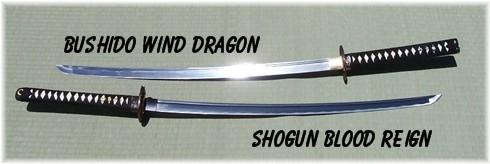
This article serves as a beginners introduction and overview to understanding the real thing: an Authentic Samurai Sword primer if you will. Plus we will also bust a few myths, and yes - we will probably upset a few purists in the process (always good fun).
So let's get into it!
Forging an Authentic Samurai Sword
Antique Japanese swords, the most expensive ones hand made in Japan, and the high end traditionally forged Katana feature three distinct processes: folding, laminating and differential hardening (i.e. claying them and heat treating them to create the famous hamon temper line).
But how many of these processes are necessary to produce a nicely performing Katana, especially considering the quality of modern industrial grade steel? Are these processes to make an authentic Samurai sword now obsolete, and only done for the sake of tradition?
Let's take a look at the processes one by one...
Folding
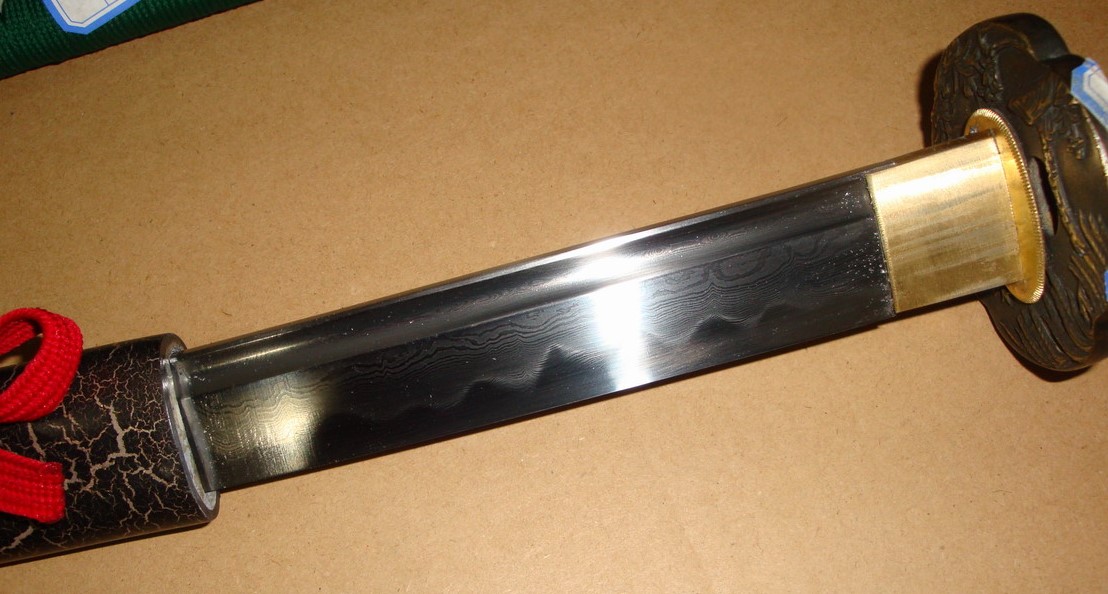
Personally, I think that the amount of mis-information and pure BS about folded Japanese swords is staggering beyond belief. Some people claim that a real Katana is folded over 1,000,000 times to create steel of such high quality that it can cut through gun barrels, armoured personnel carriers and literally everything else it touches (good old Manga and Hollywood strike again!).
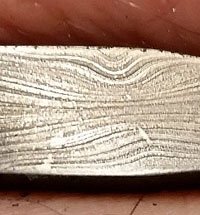
However if we strip away the BS, the truth of it is in the traditional forging process most of the steel billets that were destined to become swords were rarely folded over 15 times, creating up to a still numerically impressive 32,768 layers.
But what do these mysterious extra layers actually DO? In actuality, these days at least, not a whole lot...
In medieval Japan, the quality of iron ore wasn't very good. But the innovative Japanese metal workers took the various slags of impure iron and purified it by flame over a period of around 72 hours days in a large specially made furnace called the Tatara, creating a steel called Tamagahane (jewel steel).
But even this stuff wasn't as pure as it should be. So the Japanese sword smith would take it, and carefully fold it to try and homogenize and even out the carbon content.
These days, not too many smiths other than those in Japan still make the sword this way (Japanese smiths still have to by LAW) simply because the quality of modern steel billets or powder steel is so good that from a purely practical point of view you can literally just skip that step, or at least skip using Tamahagane and just fold it for the sake of tradition and satisfying the collector who wants a folded authentic Samurai sword.
The second and third traditional processes however are a little more practical...
Lamination
Unlike folding, which is largely done for traditions sake, Lamination does contribute to the essential physical characteristics of the Authentic Samurai sword.
There are many different ways it can be done, and many different names for the ways such as Kobuse (the most simple), Sanmai, Shoshu Kitae (the most complicated) etc. Some of the most common methods are shown below.
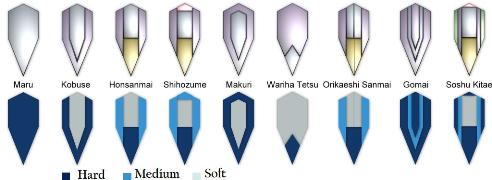
However, apart from the Maru style (what we call today a monosteel sword) they all have one thing in common. They are basically taking billets of steel of a different hardness and fusing them to create a blade designed to hold a sharp edge without snapping...
So while the techniques differ - the general principle is to create a blade with a very hard edge, surrounded by a more flexible jacket. As a rule of thumb, the more complicated the technique the more valuable/expensive the sword is (assuming it is done right that is!).
Claying and Differential Hardening
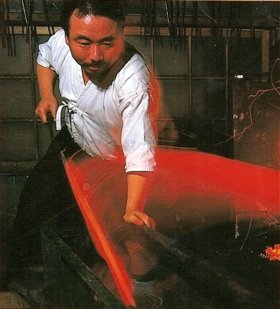
So far, we have determined than an authentic Samurai sword is folded (for traditions sake) and laminated to create a hard inner core with a hard exposed edge and a more flexible jacket. And now, the concept of a hard edge and softer spine is taken one step further and the famous Japanese hamon is created in the process...
Stripped down to the basics, the blade is covered in a layer of carefully applied clay, with a thick layer on the spine and a thin layer on the cutting edge.
It is then heated up to a predetermined temperature (approx 750 degrees Celsius) and quenched in water.
And what happens is that, as if by metallurgical magic the edge that cools faster than the spine transforms into a totally different kind of steel called martensite the hardest steel there is.
So the end result of this procedure blade can take a serious edge, and keep it while the rest of the blade stays nice and flexible...
Modern Production made swords for a collector on a budget
Most swords made to satisfy the production market rarely have all three of the essential characteristics of an authentic Samurai sword, and those that do typically start at around the US$1,000 mark...
So if you can only have one of these characteristics, which one should it be?
I think we can already rule out folded swords. While the patterns they produce look nice (though are generally subdued by polishing on an authentic Samurai sword), they arguably add nothing to the swords overall functionality (indeed, the cheaper ones are usually actually weaker for it with poor welds between the folds creating air pockets!).
So the toss up is between lamination and differential hardening. In truth, both achieve about the same kind of results assuming the correct combinations of steel are used in the laminating. However, there is little doubt that the most popular method is differential hardening...
Why?
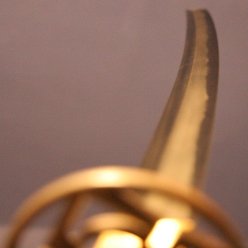
Because it not only achieves an almost identical result as laminating but as a by product it produces a real hamon, such as on the wildly popular $300 Kaze and Kaze Ko Katana, pictured right.
The downside to an authentic Samurai sword is that, especially production pieces, is that they are prone to taking a permanent bend (set) easier than the monosteel ones. The reason why is because, with two or more levels of hardness in the steel, any significant lateral force risks causing the blade to bend permanently out of shape while other Maru (monosteel) swords, if made of a good steel and properly heat treated, should return to center.
You can see a graphic example of a bent authentic Samurai sword in the picture below, in this case a $2,000+ Yasha Katana that had been folded, laminated and clayed...
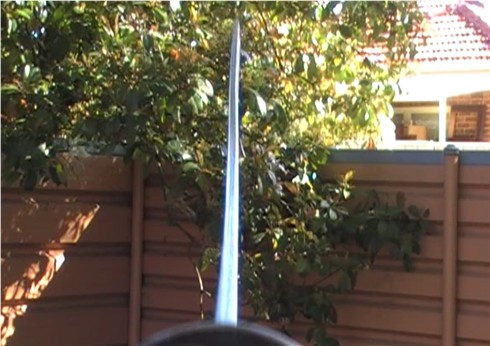 Often, the more traditional and expensive swords are not as tough as the cheap ones..
So why bother with a traditional Katana at all...? Well, I am glad you asked..!
Why even bother with traditional blades?
While modern replicas in all shapes and sizes are very cool, and quite a few having characteristics that make them perfect for introductory dojo cutters, unlike a truly authentic Samurai sword, they are somewhat soulless... The truth is a traditionally made Japanese Katana is a unique work of art and the outward manifestation of several artisans working together and striving for perfection of form and function.
The videos below should give you some idea of the various levels and what seperates them - from the cheapest swords to the highest end Chinese production swords - and then the real made in Japan Shinken...
VIDEO: Sword Making in Lonquan
Yours truly on location in Longquan, China giving a behind the scenes tour of Katana from wallhangers to high end production blades
Now compare this with an overview of the traditional forging process with some of Japans most respected smiths.
VIDEO: Sword Making in Japan
BBC documentary on sword forging in Japan
And after seeing it, I'll let you be the judge of whether or not they are worth the price tag...
Further Resources
Without a doubt my favorite book on the traditional manufacturing processes of the authentic Samurai sword, and considered by many to be the bible of Japanese sword enthusiasts, The Craft of the Japanese Sword is the best source for further information on the subject.
Simply an amazing read, it is an absolute MUST HAVE for anyone interested in Japanese swords, providing a solid and reliable foundation of knowledge to refer back to and build upon.
Highly recommended.
I hope this information on the authentic Samurai sword has been helpful. To return to A Beginners Guide to Authentic Japanese Swords, from Demystifying the Authentic Samurai Sword, click here
Buying Swords Online Can Be DANGEROUS!
Find the Best Swords in the:

Popular & Recommended ARTICLES


VISIT OUR SPONSORS: