- Home
- Ultimate Katana Buyers Guide
- Traditional Katana
Affordable Replicas of Japanese Swords
Japanese swords are very popular. They come in many different styles and are available at many different price points.
As such, it can be hard for the beginner to make sense of it all and get the most authentic replica - at a reasonable price point. And that is where this guide comes in..
Here we will take a close look at fully functional Replica Japanese swords that you can readily buy between $150 to $500 (aiming, whenever possible, to keep the price sub $300) that closest match the real thing due to one special forging technique known as differentially hardening..
Traditional Differentially Hardened Katana
MORE INFO
For more info on the various techniques used to create an authentic Samurai sword, click here
There are several techniques used in the forging of
authentic Japanese swords that are replicated on $150-$500 Katana.
The most common technique is folding ("Damascus Steel"). It sounds fancy, but all it means is that when making authentic Japanese swords, traditionally the steel is
folded in on itself several (from 7 to as many as 16) times to remove impurities inherent
in medieval Japanese steel, which was of a somewhat poor quality and
consistency..
These days, considering the quality of modern steel, such techniques tend to be of cosmetic value only (i.e. they don't make the sword and BETTER, indeed they can sometimes make it worse!!).
Another more advanced technique used to make authentic Japanese swords is lamination,
but this takes a master to do it properly, and so is too cost
prohibitive - decent laminated swords start at at least $1000, no where
near the sub $300 price point we try to aim for..
But there is one additional unique technique that is still very relevant in the creation of authentic Japanese swords - a technique that is difficult to do correctly but not so much that someone cannot be trained to do it well, and the by product of this process is the wavy and beautiful temper line on the edge of the blade that authentic Japanese swords are renowned for: the Hamon.
The SBG Gallery of Entry Level Hamon!
(click on the images to open - can you spot the fake?)
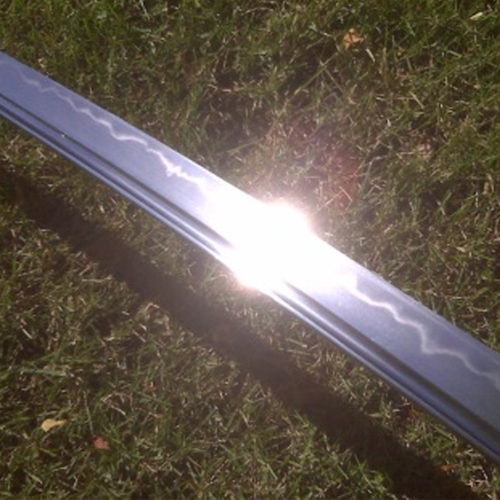
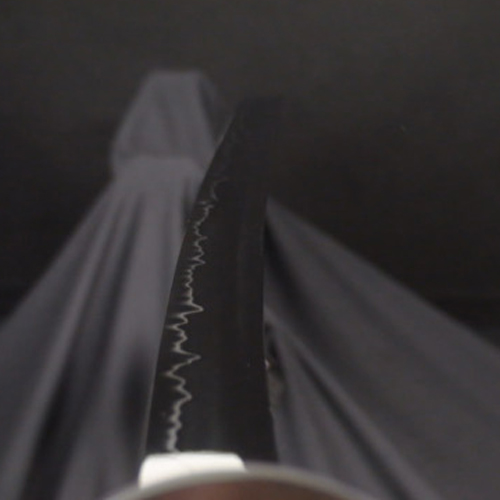
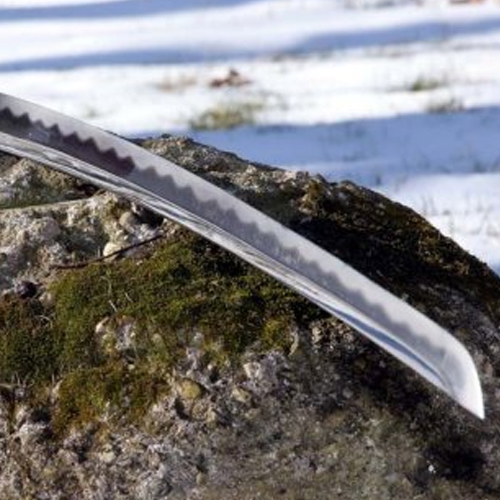
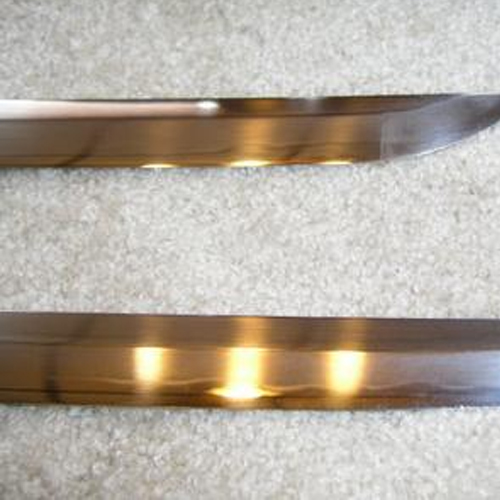
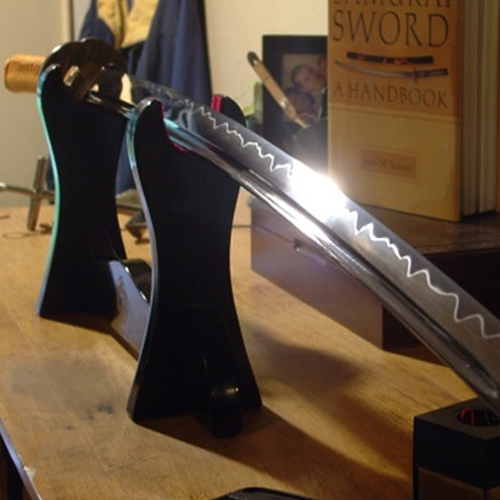
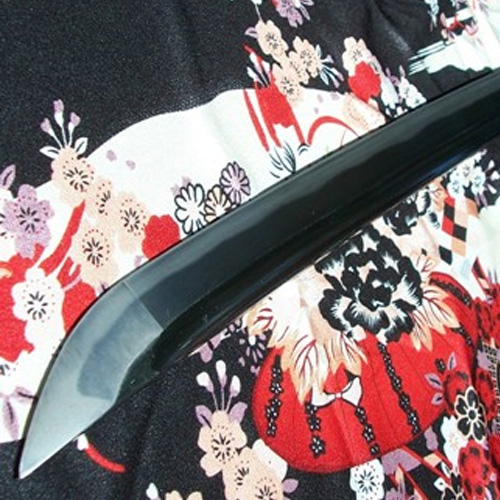
A real hamon is the result of differential hardening. In other words, the edge of the sword is made much harder than the shock absorbent spine.
If authentic Japanese swords were as hard all the way through as they are on the edge, they would be too brittle to use in combat. On the other hand, if there were as soft as they are on the back, they would quickly lose their edge.
The differentially hardened sword thus combines the best of both worlds, and is achieved by a process that involves covering the spine of the sword with a special clay before heating and quenching the blade, hardening the edge and creating the visible temper line between hard and soft.
99% of all 'Samurai swords' in our target price range have a fake acid etched or stencil ground 'hamon' because, naturally enough, this process adds a fair amount of time and extra costs into the production of a sword. As a result of this extra cost and effort, there are only a handful of swords to choose in our sub US$300 price range from that are truly differentially tempered (though the number is steadily growing)...
Below is one of cheapest, though - as might be expected - due to price point limitations a miracle cannot be expected..
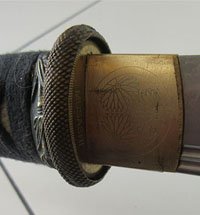
Musashi Bamboo Fast Cutter
I designed this one, but did not quite nail my design idea - though it came close.. $199.99

For the serious collector or practitioner, you need to spend a little more money. But not anywhere near as much as you might expect..
Martial Arts Grade Katana by Hanwei
Probably the best known Katana with real hamon in our target price range are the Practical Katana series by Paul Chen, owner of the Hanwei forge.
The
original and the first ever sub $300 Katana was the Practical Katana
series - the Practical, Practical Plus and the Practical Pro. Chances
are your local dojo still has one knocking around somewhere. And for
older collectors like myself, chances are your first real Katana was
probably a Practical Katana or a PPK (Practical Katana Plus).
The only problem is, with increased competition they are not quite the value that they used to be (and are not sub $300 anymore). But they aren't THAT dated yet - and the fact that they are still in production and selling strong must mean that Hanwei got something right the first time...
So let's take a closer look.
Hanwei Forge Classic Practical KATANA Series Reviews
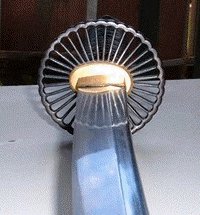
Hanwei Practical Plus Katana
The original entry level Katana. May be an old model but still holds it's own $399.95

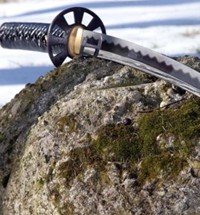
Hanwei Practical Pro Katana
Solid blade and extra long handle on this Paul Chen Classic $389.95
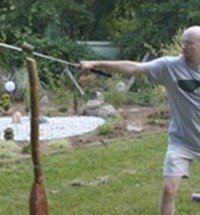
Hanwei Practical Katana
Was great value once, but the PK is showing its age $298.95

The influx of new differentially hardened Katana on the market from a variety of makers challenged Hanwei's number one position. It became sink or swim time for the Hanwei forge in our sub US$300 price range, as the standard 'Practical' series started to look more and more dated..
Instead of just lowering their prices, Hanwei stepped up to the challenge and drastically improved their entry level functional replica authentic Japanese swords range with their Elite and XL blade geometry lines.
While these swords are not the strongest or most durable in our price range, they have the keenest, most frighteningly sharp blades - 3' long razor blades, though with all the attendant limitations you might expect from such a sharp sword as well..
But used with precision and care, they are certainly a whole lot of fun, and put Hanwei back in the game again.
Hanwei High Performance Katana Reviews
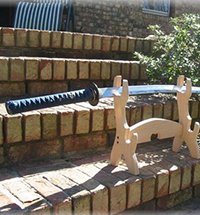
Hanwei Practical Katana Elite
A step in the right direction with this 3' razor blade by Hanwei. $319.20
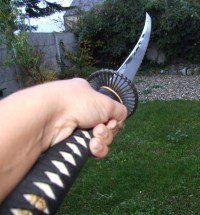
Hanwei Practical Plus Elite
An excellent sword for the money with several huge improvements over earlier models. $449.95
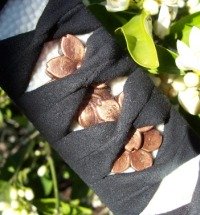
Hanwei Practical XL Light
Crazy sharp blade geometry, but maybe just a little too sharp for its own good.. $319.20
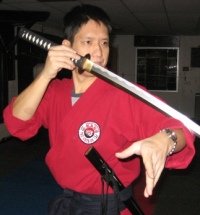
Hanwei Practical XL
Good for cutting light targets, but lacks versatility $319.20
Other Functional Replicas of Authentic Japanese Swords
So far we have covered the biggest players in our sub $300 Katana field, the lighter weight blades by Musashi and Munetoshi and Paul Chen's Hanwei Forge. But every now and again, another player steps in to give it a try..
To
date, none have quite succeeded in cleanly and clearly taking the title. But here's one that turned out to be something of a diamond in the rough..
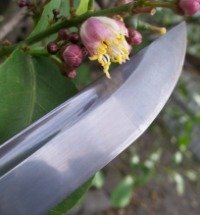
Ryumon Dragon Katana
Often overlooked, but something of a diamond in the rough $205
And below is one from the archives that kind of flopped..
Indeed, it exhibited many of the worst characteristics of entry level Katana - but it had an interesting surprise, and proved once and for all that a blade that seems blunt to the touch, could still lop your arm off..! So even though the sword never sold many units, it had some timeless lessons for us all.
DISCONTINUED SWORDS - REVIEW ARCHIVE
Click on the image for the Archived Review
Valiant Armory Kobuke: By Valiant Armory didn't quite get it right. The fittings were awful, the blade looked ok but seemed blunt as a stick and only the saya looked good. But it cut. Surprisingly well. It may be discontinued, but this is a must read review.
RYUJIN CUSTOM KATANA
Finally, inspired by the (now discontinued) SBG Custom Katana Project - one of the most exciting sword projects that started in 2015 was the Ryujin Katana line which was the brain child of one of the founders of Musashi Swords, Mr Sam Sung..
Taking the same style of T10 tool steel sword as the SBG Custom Katana, the number of options are less - but what makes them revolutionary is how FAST they are made as they are assembled in the USA..
And they cut pretty well too - with the most basic model proving to be surprisingly durable..

FEATURED REVIEW
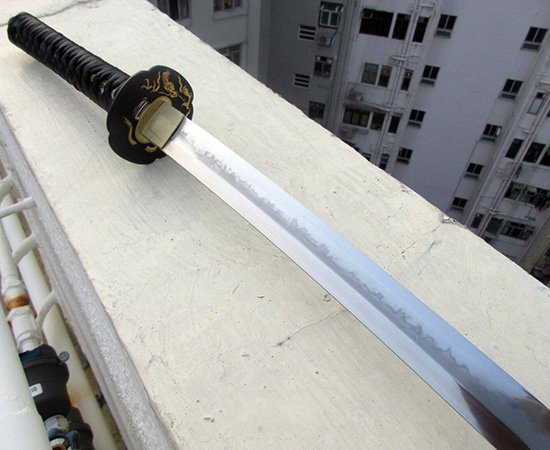
Ryujin Custom Katana
The concept was revolutionary - import the bare blades and katana parts and assemble them to the customers preference within a week!
SBG helped test and refine the concept. Out of three swords tested, one failed, one did okay and the other exceeded all expectations. $299

Ryujin Custom Katana
A second opinion review of this customizable sword from Ryujin reveals it is definitely a great value for money buy. $299
Further Resources
There's an absolute mountain of information on authentic Japanese swords over at the various Sword Forums - just using the search function there will uncover an absolute goldmine of useful info, user reviews and more. Check it out - highly recommended, though almost as addictive as collecting authentic Japanese swords! ;-)
Sources for Tatami Mats
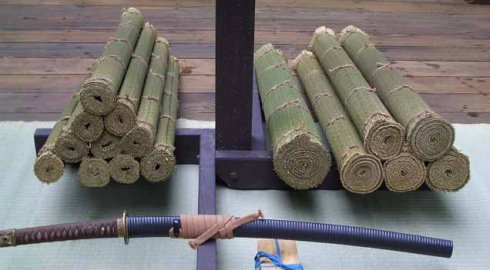
Since the MugenDachi Company stopped selling tatami mats direct to the public in 2009, it has become increasingly hard to source good quality tatami mats.
Some lovers of authentic Japanese swords have resorted to using beach mats, however it takes up to 3 to 4 beach mats to equal the same level of resistance that a single tatami mat offers, making this something of a false economy..
Luckily, there are now three main distribution points for real MugenDachi tatami mats here at Sword N Armory for the North American market, Karasu Swordworks in Europe and Ozi Tatami in Australia.
Happy (and safe) Cutting!!
Archived Reviews
Reviews of currently unavailable or discontinued swords:
- Global Gear Makaze Katana
- Cheness Cutlery 9260 Spring Steel Kaze Katana
- Cheness Cutlery Kanbai Katana
- Cheness Cutlery Laminated Higo Katana
- SBG Custom Katana Project
I hope this information on authentic Japanese swords has
been helpful. To return to A Beginners Guide to Authentic Japanese Swords, from Affordable Replicas of Japanese Swords, click here
Buying Swords Online Can Be DANGEROUS!
Find the Best Swords in the:

Popular & Recommended ARTICLES


)
)

VISIT OUR SPONSORS: