Recent Articles
-
July Issue of the Digest Out Now
Jul 01, 25 01:22 AM

Hanwei's Practical Katana (the PK) Review
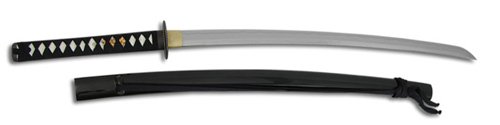
For a long while the Hanwei Forges Practical Katana (affectionately abbreviated to the PK) was considered to be the most basic, least expensive functional Japanese Samurai Sword you could buy.
Boy, things sure have changed in the last few years !
These days, the variety of cheap, stripped down to the basics Katana like the PK is truly overwhelming. So with all this competition, it's interesting to see how it stacks up, especially as it's price has gone UP, not down, in recent years..
In this review, one of the earliest on SBG that was submitted just as the competition was heating up, we can see the PK in it's own light, judge it own it's own merits, so you can decide for yourself if it is right for your own needs..
Hanwei Forge Practical Katana Review
Review by Michael Mahaffey, Michigan, USA
|
Steel Weight Point of Balance Price Range |
1095 Carbon Steel 2.32lbs 4.92" US$300 to $350 |
I started collecting functional swords one year ago.
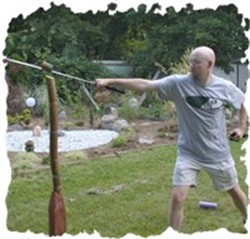
After almost 20 years of martial arts and weapons training (although admittedly never in a sword art), and several years of collecting knives and other pointy instruments, I finally decided it was time to take the plunge and purchase my first real sword.
I already owned two wallhanger (non-functional swords useful only for decoration) katana, and was itching for something that I could actually use to safely practice some cutting with if I wanted to. After much Internet research I decided on the affordable and (somewhat) popular Paul Chen Practical Katana.
I initially chose the Practical Katana (PK) for several reasons.
Not the least of which was the price: after some digging, I found it at for a steal at $133USD.
EDITORS NOTE
The price of the PK has risen steadily since this review was written back in 2005 and now sells for between $300 to $350 depending on where you buy it.
Prior to my purchase I had familiarized myself with prices of blades in the functional sword world, and had become thoroughly intimidated. As a new father with bills to pay, my sword fund would initially be limited, and there was no way I could justify several hundreds of dollars for my first sword.
The next reason I chose the Practical Katana was its reputation although not everyone I ran into in the sword community was a fan, enough people had started their collections with this sword that I felt it was worth looking into. I was fully aware going into my purchase what some of the drawbacks of this sword would be, but given the price, I hoped that this deal could not be beat when it came to my first functional sword.
What follows is my review of my first sword ever: The Hanwei Generation 5 Paul Chen Practical Katana.
Note that I stated earlier that I do not formally train in any sword art. Therefore, this is not the review of a Japanese Sword Arts (JSA) practitioner. I am merely a weapons enthusiast with a soft spot for sharp, pointy, shiny things. I will be as impartial as I can, and do my best to use correct Japanese-styled sword terminology.
Feel free to disagree with any of my conclusions in this review the great thing about collectors is we all love our collections for different reasons.
First Impressions
My sword arrived via UPS on my doorstep only three days after I placed my order. My son and I were alone for the evening (my wife was working late), and I had just put him to bed. I happened to step out to take out the garbage, and was confronted with an oblong brown box on my side porch the sword-fairy must have stopped by while I was rocking my baby to sleep!
With all the patience of a kid at Christmas, I hauled the box into my living room, got my digital camera, and proceeded to unpack my first real sword!
Underneath the brown UPS cardboard box was a stately looking Hanwei box glossy black decorated with white bamboo, the CAS Iberia logo on the left, and the Hanwei logo on the right. I must have stared at that box for a full five minutes, just letting the excitement build before unveiling my new sword.
When I opened the Hanwei box, I found the Practical Katana packed tightly in Styrofoam. The sageo (scabbard-cord) was wrapped tightly around the saya (scabbard), but not tied. A CAS Iberia tag was attached to the tsuba (guard). The saya was lacquered a glossy black, and was smooth and unscratched.
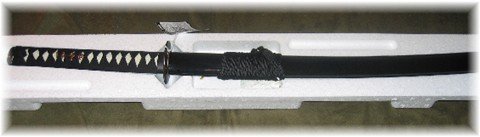
I gingerly lifted the sword out of the box and slowly unsheathed it.
The first thing I noticed upon handling my first functional sword was how different the balance was from my stainless steel wallhangers. This sword seemed heavier, with a balance point farther from the tsuba.
I swung it (slowly and carefully) around the living room, and decided it was not unwieldy; it just had a lot more blade presence than my decorative pieces. It was obvious that I was finally holding a sword that was made to cut!
The Fittings
My first impression of the fittings was that they looked simple and elegant. I must admit that my tastes have changed somewhat as I become more educated about what makes a nice Japanese-styled sword.
I still find some things I appreciate about the Practical Katana's fittings, but most of them, in my recent opinion, leave much to be desired.
What I still like about the fittings are the tsuba, fuchi (metal collar around the tsuba end of the handle), and kashira (pommel cap) all are a nicely antiqued iron, and all feel quite hefty and solid.
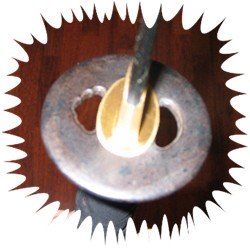
I especially like the simple, unadorned, antiqued tsuba.
As I continue to collect katana, I find myself wishing that I could find more tsuba like this one, as I think it would look great on some of my other swords.
What I do not like about the fittings is, well, everything else.
The ito (handle wrap) is synthetic suede. While the ito is tight and feels fine as I grip the tsuka, the diamonds created by the wrap are very uneven, and are aesthetically unpleasing. The tsuka is also the infamous Hanwei axe handle it is thick, straight, and does not follow the curve of the blade at all.
The same (rayskin) underneath the ito is fake (plastic panels), and looks nothing like the real thing. The menuki (handle ornaments underneath the ito) are plastic cherry blossoms painted to look like copper. These fooled me for a while, and for several weeks I actually thought they were real copper. But it is obvious upon closer inspection that they are plastic, and as I become a more discriminating collector I cannot stand the thought of plastic parts on a sword.
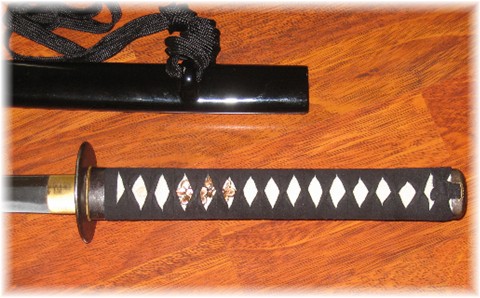
The seppa (spacers between the tsuba, tsuka, and blade collar) and habaki (blade collar) are plain brass, and are attractive enough, but are nothing special.
The real deal-breaker is the way the fittings are attached to the blade.
Instead of the tsuka being friction-fit to the nakago (tang) and held by a bamboo mekugi (peg), the entire assembly is glued to the sword.
Although this makes for a sturdy, near unbreakable fit, it
removes any possibility of customizing the swords furniture. As I
continue to collect, my thoughts turn to do-it-yourself customization,
and I lament the fact that I cannot customize this blade.
The Blade
The blade of the PK makes up for some of the issues with the fittings.
It has a decent polish, and a bright, suguha (straight) hamon (temper line) that is very attractive. I understand that the hamon is etched to make it more prominent, but it is also real, as this sword is differentially tempered to provide a harder cutting edge and a softer spine to absorb the shock of a blow.
The yokote (line of demarcation between the blade and the tip) is cosmetic but prominent. This blade (unlike some of my other katana) was flawless and shiny right out of the box.
Handling
The Practical Katana handles well enough. It is not a super-light sword, but it is still easy to accelerate and change directions mid-cut.
The tsuka is 11 inches long, and my preference would be to add another inch, which would change the point of balance enough to make this already decent sword feel quite a bit faster. Alas, with the tsuka glued on tight, I must be satisfied with what I have.
Structural Integrity
With everything glued together, I have no fear of this sword flying apart on me during use. The ito is tight and has not shifted after a year of intermittent handling. The blade, while not the thickest I have used, has handled everything I have cut with it pool noodles, water bottles, beach mats, and half-rolls of tatami with ease.
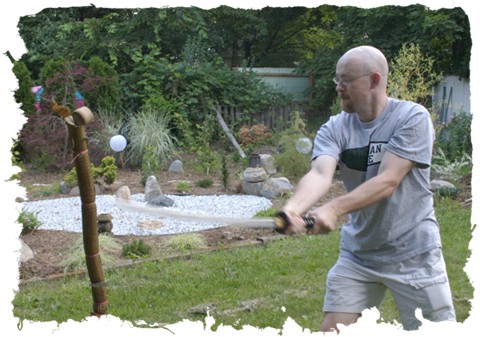
The edge retention is superb. It is as sharp a year later as the day that it arrived.
The only damage it has taken is a scratch on the body of the blade, about six inches from the kissaki, from clipping the cap on a milk jug full water. I have no problems with my blades getting battle scars, however. It shows they have been put to loving use.
Conclusion
I would not recommend the Generation 5 Practical Katana to anyone looking for a more traditional sword, or anyone interested in customizing their swords.
The Practical Katana is far from traditionally constructed plastic fittings and a glued-on tsuka are unheard of in real Japanese swords, and are scorned by serious collectors. In my opinion the Practical Katana is a sword for novice collectors, and when I first started collecting, I appreciated it for what it was.
Thanks for reading, and happy sword shopping!
Michael Mahaffey
PROS
- Decent, differentially hardened Hanwei blade
- Iron Tsuba, Fuchi and Kashira
CONS
- Cheap handle fittings (plastic rayskin and ornaments, cheap overly large synthetic ito)
- Due to the tsuka being glued on, cannot be disassembled for customization. Nowdays only $50-$100 swords are usually glued and even this is becoming rare..
- Fittings and assembly method are outdated now, the blade and the Tsuba, Fuchi/Kashira are good but everything else is off.
- Price has risen dramatically, but the product has not changed or improved in the years since it was first introduced to the market (though there is a different model based on it that IS considerably better - and that is the 'Practical Katana Elite' reviewed here

WHERE TO BUY
While it is somewhat outdated, it is still Hanwei's cheapest blade and it is still a worthwhile purchase, but it just doesn't quite stack up to other options currently available for a similar price.
Prices have increased in recent years, but the best price currently is $298.95 HERE at Kult of Athena, $80 less than the manufacturer direct price of $379
I hope this review of the Practical Katana has been helpful, and thank Mike for his contribution. To return to A Beginners Guide to Buying Authentic Japanese SwordsfromThe Practical Katana Reviewed, click here
Buying Swords Online Can Be DANGEROUS!
Find the Best Swords in the:

Popular & Recommended ARTICLES

VISIT OUR SPONSORS: