- Home
- READ THIS FIRST!
- Types of Swords
Types of Swords
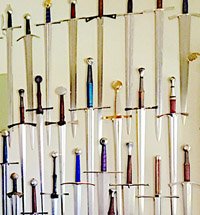
There are so many different types of Swords that it can be difficult to conclusively classify them into neat groups and categories.
One respected sword scholar, Colonel D.H. Gordon, a British army officer trained in sabre and bayonet fencing pre-WWI suggested that weapons less than 14" long should be classified as daggers, 14-20" long as dirks, those 20-28" as short swords and anything over that length as longswords.
Nice and easy, but of course this refers to Western swords only. So below we have grouped together a few basic types of swords not so much by their length but geographic and cultural region as well as their primary function.
Asian Swords

Perhaps the most diverse and exotic types of swords, Asian swords include straight, doubled edged Chinese longswords (Jian) and single edged Chinese Sabers (Dao), as well as a myriad of other exotic weapons favored by martial artists the world over. Click here for information on functional replica Chinese swords.
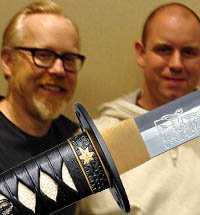
However, probably the most impressive and specialized of all Asian swords are the Japanese swords most notably the Katana, a single edged, slightly curved sword with a blade around 2.5' in length.
Designed specifically to cut through human flesh and bone, in the hands of an expert swordsman the Katana was fully capable of cutting a man diagonally in half with one clean blow (though it was a highly specialized sword and could not cut gun barrels in half, chop down trees or cut stone as some modern Manga and Anime may have you believe). Click on the link below for more information on Authentic Japanese Swords.
Egyptian Swords

Egyptian swords were bronze weapons, typically elongated daggers and dirks, and like many ancient swords were used more as a weapon of last resort, with ancient armies favoring spears, pikes, javelins and the bow and arrow.
Of note though is the exotic combination of sword and sickle called the Khopesh, which was commonly used to ritualistically behead captured enemies after a battle and was the most feared sword of the ancient world.
Click here for information on modern replica Khopesh.
Foils and Rapiers

Foils and Rapiers were long, slender bladed swords designed to empathize the thrust and were one of a very few civilian swords ever devised. Appearing first in the 16th century, these swords were primarily used for dueling, a popular fad of these times and for several centuries after...
Surprisingly heavy, a true rapier was much longer and slower than the types of swords used in modern fencing. There are also several types of swords related to the rapier, such as the epee or the 'smallsword'.
For more information on Rapiers and Renaissance swords in general click here.
Two Handed Swords, Claymores and Flamberges

Two handed swords or Great swords were a specialized weapon up to 6' long that were especially popular in the 1500s to 1600s. The precise military role of these swords is a matter of debate for scholars, though many tend to believe that they were primarily used in 1 on 1 duels and single combat, yet no doubt were also quite useful to 'shock troops' in the front lines to cleave a path through the enemy.
The term Claymore is a derivation of the Gaelic "claidheamh-more" (great sword) and was frequently used by the Scottish Highlanders against the English in the 16th Century.
Flamberges were unusual swords somewhat popular with officers and the upper classes in the 1600s. With scalloped, serrated edges these swords were believed to slow an opponent’s blade slightly as it passed along its length and deliver a more deadly wound (ouch).
You read more about these types of swords on our medieval swords page here.
Longswords and Bastard Swords
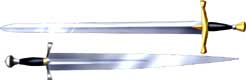
The term 'longsword' is actually quite nebulous and can refer to many different types of swords depending on the context and time period (as we saw earlier, Colonel D.H. Gordon defines a ‘longsword’ as a sword with a blade over 28” long!)
In previous time periods, longswords referred to one handed swords that were typically used in conjunction with a shield or buckler (also known as 'broadswords or arming swords').
However, these days, it is generally accepted by modern sword scholars that the term long sword is used to describe a sword words a straight, double edged sword that is between 4 to 4 and ½ feet long, with an average weight of 3 to 4lbs and a pommel that reaches your armpit when it is laid tip first to the ground.
And a bastard sword? Well, it’s very similar to a Longsword but less pointy (and can be used either one handed, but preferably with the off hand guiding the pommel).
Within these two broad groups, there are many types of swords classified by the late, great sword scholar Ewart Oakeshott – but I try to steer clear of his typology as it is very advanced, and tends to cause flame wars on the various sword forums as the distinctions between the different types of swords he identifies are often somewhat nebulous and can make people act like – er - well..
For more information on longs and bastards check out this section of our medieval swords page.
Scimitars, Falchions & Sabers
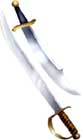
About 3' long, these swords all have a curved, single edged blade and were a popular cavalry weapon and military blade with the scimitar, an Arabic sword, having a more noticeable curve.
The Falchion was the principal side arm of medieval peasant conscript soldiers as it was easy to use and its heavy blade weighted towards the point was capable of delivering tremendous blows that were effective against heavy armor (and everything underneath it!). Indeed, due to this factor and it's relative ease of use, it was probably the most numerous medieval sword of all time!
You can read more about modern replicas of these three main types of swords on our Slicers, Scimitars and Choppers page here.
Short Swords

Short Swords usually have a total length of around 2' (which of course for a sword, is relatively - short) and historically were almost always used with a shield in the other one hand. Favored especially by the Roman Army (but also by the Greeks and other ancient world warriors) these swords have within their family the Spatha, the Gladius and several other variations. Click on the link for more information on these Ancient Swords.
I hope this information on different types of swords has been useful. To return to
WARNING: Do Not Buy Swords Online Until You Read This From Types of
Swords, click here.
Buying Swords Online Can Be DANGEROUS!
Find the Best Swords in the:

Popular & Recommended ARTICLES


VISIT OUR SPONSORS: